

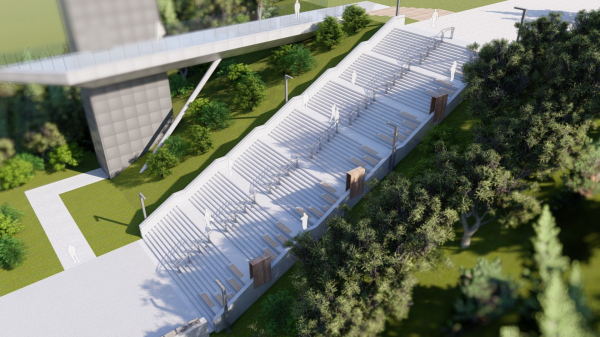
For Postechians, there are many important facilities on campus. However, if there is one facility that stands out above all others, it would undoubtedly be the 78 Stairs. The reason for the 78 Stairs’ importance is quite simple: it serves as a bridge between the dormitories and lecture buildings. The importance becomes more prominent during the morning rush, when every second and minute counts. However, if you head toward the 78 Stairs now, you will find this familiar landmark is under repair.
For a deeper understanding, the brief history of the 78 Stairs may help explain what is happening. Originally, the 78 Stairs was built when POSTECH was established. As this article is being written in 2026, the stairway met its 40th anniversary. Over its 40-year history, the 78 Stairs has undergone numerous changes alongside the campus. Fences were added, the worn steps were repaired, and so on. Still, the main frame of the stairway remained unchanged, meaning the structure of the stairs is almost the same as they were 40 years ago.
But times have changed. As the years passed, damage to the stone steps and other structural issues, such as sagging, continued to emerge, while relevant laws and regulations were also amended. According to the Facility Management Team, the 78 Stairs had reached a point where minor repairs were no longer sufficient, making comprehensive repairs to the entire stairway necessary. The Facility Management Team also noted that they had been aware of the issue since early this year. After that, the Team proceeded with the design service from March to June. The contracting process and administrative procedure were executed subsequently. By the time the contract for construction was finalized, it was already the end of August.
The construction has inevitably caused inconvenience for most students, as the 78 Stairs is the shortest route connecting the dormitories and the lecture buildings. One student commented, “During the busy morning rush, it’s frustrating to have to wait for the elevator. The detour is also too long, which makes getting to class much more difficult.”
However, according to the Facility Management Team, postponing the work until winter could have compromised the quality of the concrete due to lower temperatures. As a result, the current schedule was necessary to carry out the repairs under suitable conditions. The Team also noted that a detour could not be built because of the steep slope of the hill.
The planned changes of the 78 Stairs are focused on improving structural safety and user convenience, while preserving its historic identity. First of all, the 78 Stairs will be rebuilt with block steps instead of stone treads. Stone treads use individual stone slabs as the walking surface, while block steps are built from concrete blocks. Stone treads are vulnerable to cracking and displacement over time, making them more difficult to maintain. Also, the landing will be elongated according to the current law. Subsequently, more lights and the wooden benches will be installed. Despite the changes, it is planned to make the identity of the 78 Stairs remain intact.
The construction is planned to end by Nov. 30.
