

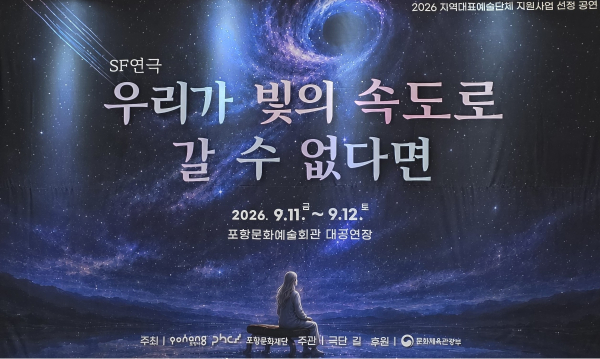
You’re probably familiar with the novel If We Cannot Go at the Speed of Light by KIM Cho-yeop. However, the work I’d like to introduce today is a science fiction play of the same name, based on the novel, performed at the Pohang Culture & Arts Center on Sept. 11 and 12.
The play and novel essentially share the same approach: the implicit “promise” made to the audience and the reader. It is the promise that this space is not the Main Auditorium of Pohang Culture & Arts Center, but rather an old space station abandoned on the edge of the universe. The production cleverly brings the isolated station to life by breaking down the boundaries between the stage and the audience seating area and drawing the audience into the stage itself. The audience finds themselves by the old structure, the fading lights, the malfunctioning guide robot, and Anna, an elderly scientist left behind alone in the desolate wreckage.
The central conflict running through the work comes from the disconnect between technological leaps and the inherent pace of human life. Once highly efficient warp navigation became commercially available, the wormhole passages and cryogenic sleep of the previous era were instantly discarded. Hence, the government permanently closed the wormhole space terminal for efficiency reasons, cutting off the only path to Anna’s family in Slenfonia. Her time also froze at that moment. Because the technology she had continuously researched and her entire family were now completely severed from her. The actors’ heavy breaths and trembling fingers on stage pierce the audience’s hearts with a vivid intensity that the novel cannot convey. The play delicately portrays Anna’s determination as a researcher and the sorrow of her interrupted career. Furthermore, it highlights her regret over abandoned research and her endless longing for an unreachable family. Amid dialogue that captures the essence of the original work, the mechanical humor delivered by a malfunctioning guide robot lightens the play’s atmosphere, which could otherwise easily become too serious. Rather than silence, the constant noise of ventilation fans and machinery fills the stage. This ambient sound powerfully amplifies Anna’s loneliness and the long solitary silence she experienced.
In the latter half, the moment Anna boards a small shuttle alone toward Slenfonia, the stage is filled with a complete blackout. When a staff member discovers this, the malfunctioning guide robot finally plays back Anna’s memories. On a massive screen, the afterimages of her family, whom she so desperately longed to reach, brightly emerge and fill the stage. This scene not only shows the weight of the 170 years of isolation Anna has endured but also visually etches the love that neither progress nor separation has been able to erase.
If one cannot go at the speed of light, one may never reach the destination. Perhaps one will drift through the vast darkness until the end of one’s life, only to be reduced to fragments. Yet through Anna’s reckless flight, the play poses a deep question to the audience: Are tenderness and the desire to connect, which cannot be measured by the scale of efficiency, truly meaningless? Even after the lights come on in the theater and the illusion of the old station fades, Anna’s path, which cuts through the darkness, stays with the audience long after leaving the auditorium.
