

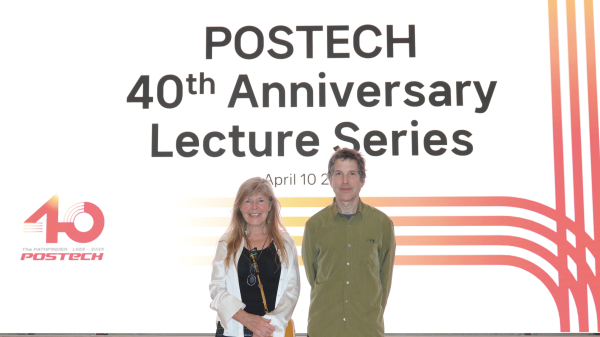
To mark its 40th anniversary, POSTECH has launched the POSTECH 40th Anniversary Lecture Series, a new program designed to invite world-renowned scholars, Nobel laureates, and visionary leaders to campus. The series opened on April 10, with a lecture by David BAKER, professor at the University of Washington and recipient of the 2024 Nobel Prize in Chemistry. Held at the Ground Pohang Event Hall, the event brought together members of the POSTECH community to hear from one of the leading figures in computational protein design.
Prof. BAKER delivered a lecture titled “Protein Design Using Deep Learning,” introducing how AI is changing the way scientists design proteins. The event also featured a keynote lecture by Hannele RUOHOLA-BAKER of the University of Washington, who discussed the future of stem cell biology and regenerative medicine.
According to POSTECH’s External Relations and Communications, the lecture series was organized to provide the POSTECH community with opportunities to engage with leading research and ideas across science, technology, and the humanities. Prof. BAKER’s role as the opening speaker carried additional significance as a Nobel laureate at the forefront of AI-based protein design and through his direct academic connection to POSTECH. Professor Sangmin LEE (CE) previously worked as a postdoctoral researcher in Prof. Baker’s lab and co-authored a Nature paper with Prof. BAKER in December 2024, the same year Prof. BAKER received the Nobel Prize in Chemistry.
A major theme of the lecture was the transformation of healthcare. Ruohola-BAKER emphasized the need for a more preventive approach, introducing three key tools for future regenerative medicine: AI-designed proteins, stem cells and organoids, and virtual cell systems that may one day predict biological pathways.
Prof. BAKER then explained the principles of AI-based protein design. While traditional biology often begins with proteins found in nature, AI-driven design works in the opposite direction. Scientists begin with a desired function, design a structure, and then generate the amino acid sequence needed to create it. Prof. BAKER introduced generative AI methods such as RoseTTAFold Diffusion, which can create new protein structures by learning from existing protein databases. These tools have enabled researchers to design proteins that bind to receptors, block inflammatory signals, recognize tumor-related targets, and interact with disease-associated proteins.
He also discussed switchable and catalytic proteins. Switchable proteins can turn biological signals on or off under specific conditions, while catalytic proteins can repeatedly act on harmful targets. Such technologies may lead to more precise and efficient therapies, particularly for difficult diseases such as neurodegenerative disorders.
The POSTECH 40th Anniversary Lecture Series will continue through December 2026.
Meanwhile, the CROWN event for Chemical Engineering students was exclusively held at the Ground Pohang Media Hall before the Lecture. Prof. LEE served as the moderator for the session. During the event, Prof. BAKER engaged in a dynamic Q&A session, providing candid answers to questions previously prepared by the CE students.
