

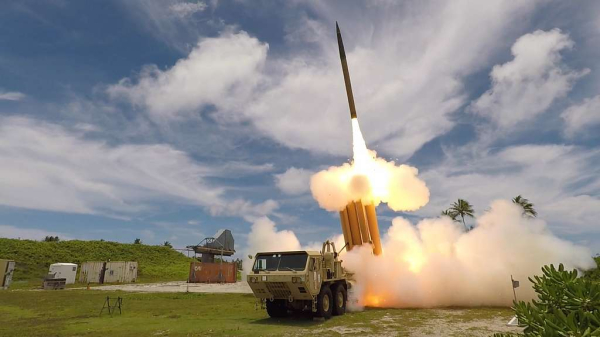
The United States has begun relocating the Terminal High Altitude Area Defense (THAAD) system, previously deployed in South Korea, to the Middle East amid the escalating conflict involving Iran.
THAAD is an anti-missile defense system designed to intercept short and medium range ballistic missiles. Its interceptors destroy incoming missiles through kinetic impact rather than explosive warheads. Each interceptor missile costs about 17.5 billion KRW, reflecting the system’s role as a significant component in the world of international security.
The system was first deployed by the U.S. in Guam in 2013, and later expanded globally to strengthen missile defense networks in strategic locations. Most notably, in 2016, Washington and Seoul jointly announced that a THAAD battery would be stationed in Seongju to counter North Korea’s rapid advance in missile and nuclear programs. The deployment became operational in 2017 and formed part of a layered missile defense system, where lower altitude threats were intercepted by the Patriot systems while THAAD handled higher-altitude ballistic missiles.
Recent reports indicate that some of the interceptor missiles in the Seongju-based battery have been moved to Osan Air Base before being prepared for transport to the Middle East. The redeployment reflects the U.S.’s effort to strengthen air defense around its forces and allies as missile and drone threats increase in the region.
South Korea has expressed concern over the move, arguing that removing part of the system could weaken national security, and that it would undo one of the intertwined layers of defense against North Korea. LEE Jae-myung, the president of South Korea has explicitly stated that while Seoul had voiced opposition, the equipment ultimately belonged to the U.S., limiting South Korea’s influence over the transfer.
Looking ahead, analysts say the redeployment could raise broader questions about security arrangements in Northeast Asia. Some warn that even a temporary reduction in missile defense capacity could heighten concerns in Seoul about the reliability of U.S. military commitments. The decision may also fuel renewed debate in South Korea over defense autonomy and the long-term structure of the U.S.–Korea alliance.
