

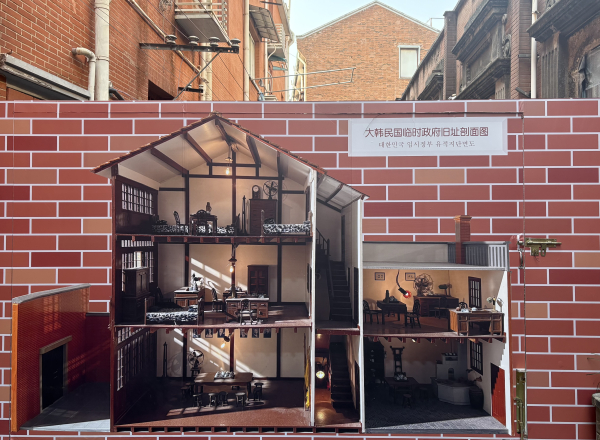
On Jan. 23, The Postech Times arrived in front of a tiny building in Shanghai, the Provisional Government of the Republic of Korea Memorial Hall. Despite the weekday morning, the site was crowded with Koreans of all ages.
The first thing we saw after entering was a flickering black-and-white film that screened the history of the Provisional Government of the Republic of Korea. It was initially established in Shanghai in 1919, and served as the base of the independence movement until it was practically forced to relocate after Japanese surveillance intensified. This escalation followed YUN Bong-gil’s 1932 bombing at Lu Xun Park (formerly known as Hongkou Park), just eight kilometers away. The screening reminded visitors of the building’s importance and set a quiet and respectful tone to start the tour.
Despite the grand name, the building’s interior was remarkably humble. There were no grand halls; the rooms were small and barely furnished with only the basics such as a bed and a desk. Stairwells were steep and barely wide enough for one person. However, everything was maintained in surprisingly great condition; it was as if I had time-traveled back to the early 20th century.
After the rooms came an exhibition space to help visitors understand the establishment and activities of the Provisional Government of the Republic of Korea. Other resistance activities related to the Korean Independence movement were also displayed, such as LEE Bong-Chang’s assassination attempt on the Japanese emperor, or KIM Ku’s efforts to rally international support by publishing anti-Japanese declarations in the Xinhua Daily. For me, this section was the most memorable, as it reminded me of the weight of actions and words, and how Koreans from various backgrounds came together for a common cause: the independence of Korea.
The site was nearly demolished during urban development, as it sits near the luxurious Xintiandi street. However, the mayor of Shanghai recognized its profound weight for Koreans, refusing to demolish the building. While this preservation also served as a strategic diplomatic bridge, the building’s future is not guaranteed; as a “guest” on foreign soil, it is under the jurisdiction of the Chinese government.
At the word “Shanghai,” people often think about landmarks, good food, and skyscrapers. However, it is also the home to the Provisional Government of the Republic of Korea and the home of Korea’s independence. A memorial hall like this helps visitors remember the past, reminding us that independence fighters left their family and their homeland behind to stand for a cause. YUN Bong-gil was just 23 when he detonated the bombs; standing where he once stood, I found myself wondering: Would I have had the courage to resist?
