

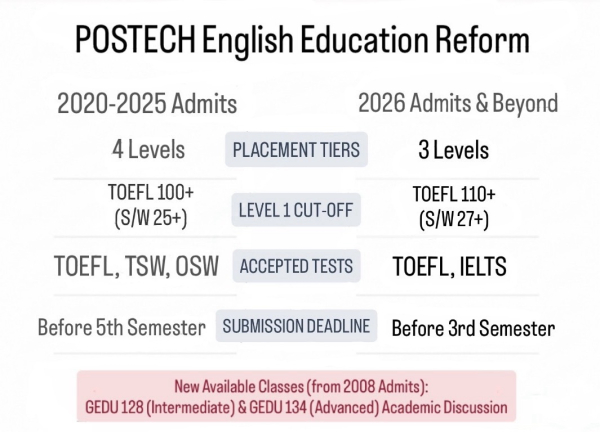
Starting in 2026, POSTECH is implementing significant shifts in English education to prepare Postechians for the global stage. The shift, aimed at freshmen, reduces the four-tier placement system to three and raises the bar for all students. Completion of these English levels is a mandatory requirement for graduation; students must either be placed into Level 1, the highest level, or pass the required coursework for the levels leading up to Level 1.
Previously, students were categorized into four levels based on their TOEFL iBT scores upon entrance. Level 1 required a TOEFL iBT score of 100 or higher, with speaking and writing scores of at least 25. Students could choose to be “regraded” via submitting their TOEFL iBT, TOEIC Speaking & Writing (TSW), or OPIc Speaking & Writing (OSW) results up until the start of their fifth semester.
However, starting for freshmen entering in 2026, requirements have sharpened. In order to be placed into Level 1, a TOEFL iBT score of 110 or higher is required, with scores for speaking and writing each being 27 or higher. All levels have been adjusted; the previous scores required for Level 1 are now the cut-off score for Level 2. The option to take TSW or OSW has been replaced with IELTS, and the period for submitting results has also been shortened to before the start of their 3rd semester. The Division of Humanities and Social Studies (HSS) cited the narrow scope and relative ease of TSW and OSW as reasons for their removal, noting they do not align with TOEFL’s rigor. Instead, IELTS was added because of its ability to test various aspects and its usage in Commonwealth countries.
Furthermore, for students admitted between 2008 and 2025, two classes will be added—Intermediate Academic Discussion (GEDU128), for Level 3, and Advanced Academic Discussion (GEDU134), for Level 2. For the reasoning behind the change, HSS has responded that this is “to enhance students’ speaking and writing abilities, which many students face difficulty with, ensuring they are better prepared for the demands of graduate school and the global workforce.”
Dokyoung OK (Mueunjae 25), who took Advanced Listening & Speaking (GEDU137) in Fall 2025, commented, “The content was generally okay to follow, and Professor Joshua PRIGGE’s class was quite interesting and fun. However, I don’t quite understand the reasoning behind different levels teaching similar content.” Regarding the categorization and passing method, she said, “I agree with making students take classes according to their level, but I have to admit it is quite pressuring to have so many general required classes.”
POSTECH’s commitment to English education is rooted in a clear goal: producing global talent ready for the world. By analyzing student performance, HSS noticed students particularly struggled with speaking and writing, and has newly added the two debate-and-presentation classes. Whether for studying, employment, or presenting at international conferences, POSTECH aims to ensure that students possess the linguistic command to navigate any environment with confidence and lead on the global stage.
