As U.S. president Donald TRUMP threatened steep tariffs on eight European countries, as high as 25%, global markets were jolted by a familiar trigger: political risk. Trump said an additional 10% tariff would begin on Feb. 1 and rise to 25% on June 1 without a deal, targeting Denmark, Norway, Sweden, France, Germany, the Netherlands, Finland, and the U.K. What made the move unusually disruptive was not only its scale but its logic. The tariff threat was tied to Greenland, turning trade policy into a geopolitical lever.
Europe’s response was swift. Leaders across major capitals framed the move as pressure on allies rather than conventional trade policy, while EU officials discussed countermeasures ranging from retaliatory tariffs to stronger anti-coercion tools. The episode quickly expanded beyond trade arithmetic into questions of credibility, alliance management and how far economic measures can be used to push political outcomes.
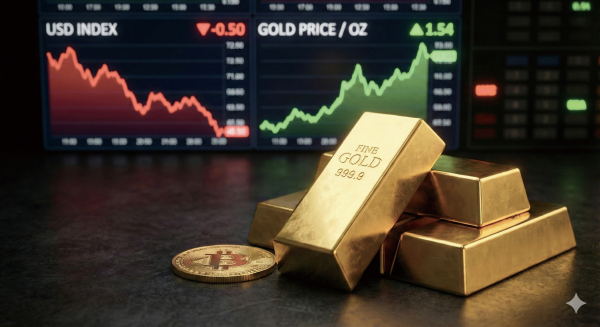
Markets reacted to rhetoric before implementation. Equities wobbled as investors rotated toward hedges, but this episode carried a twist. The dollar softened rather than strengthened, while the euro rebounded and gold surged to new highs. The gold rally was not just a headline trade. It has been supported by expectations of a lower-rate environment that reduces the opportunity cost of holding gold, persistent central-bank buying and renewed demand for stores of value amid fiscal and policy uncertainty.
The simultaneous euro rebound and gold surge is best read less as a sudden upgrade to Europe’s fundamentals and more as a signal of where investors locate the epicenter of risk. When uncertainty is perceived to originate in Washington’s policy direction, the dollar’s safe-haven premium can fade. That can revive talk of diversifying away from U.S. assets even without a full-blown crisis.
Looking to 2026, the key question is not simply whether tariffs are executed, but whether policy-driven volatility becomes the new baseline. Even if the threat softens into negotiations, markets may keep pricing the pattern of escalation, partial retreat and the possibility of re-escalation. In that environment, gold remains a default hedge, currencies swing on politics, and confidence, not data alone, sets the tone for risk appetite.