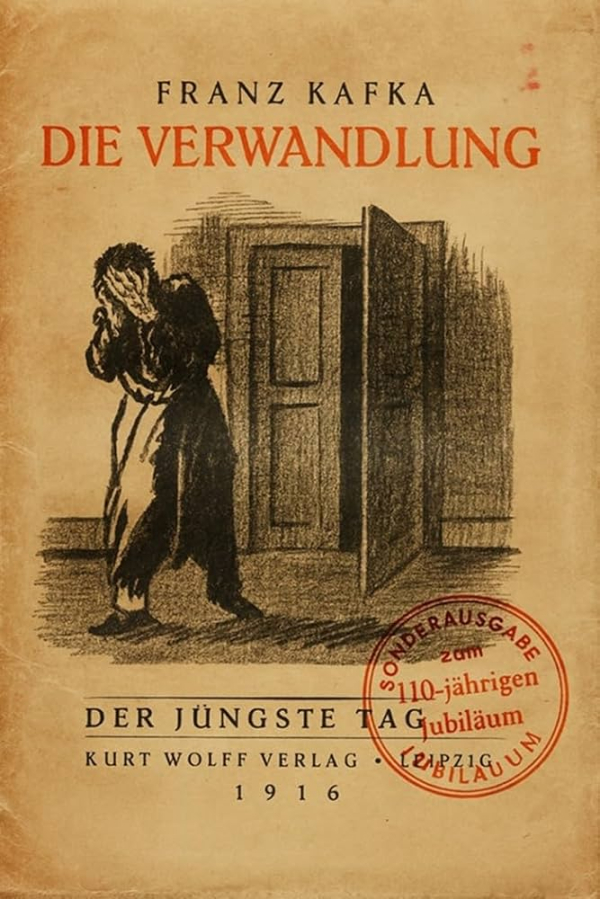
Metamorphosis is a biological process of abrupt physical transformation after birth, typically a transformation into a completely different form, commonly seen in insects. It is also the title of a 1915 novel written by Czech-Jewish writer Franz KAFKA.
The Metamorphosis (Die Verwandlung) tells the story of salesman Gregor Samsa, who wakes to find himself inexplicably transformed into a huge insec—ta “monstrous vermin”—and struggles to adjust to this condition, as does his family. Prior to the “metamorphosis”, Gregor was a loved son to his parents and a loved brother to his younger sister, and the only breadwinner to the household who worked to pay off his father’s bankruptcy debt. One morning, he simply finds himself transformed into a massive insect, unable to perform any human tasks, let alone work. He feels useless and disgusted with himself throughout the novel.
However, the metamorphosis is not just a phenomenon for Gregor. His family fires their servant and cook, and everyone starts working hard. His father gets a job at a bank, his mother starts sewing for a firm, and his sister becomes a salesgirl. In Kafka’s words, “They fulfilled the uttermost all that the world demands of poor people.” Their lives seem to have taken a turn for the better contrary to that of Gregor.
Soon, Gregor is shunned by his family, being referred to as an “it” rather than a person, even by his sister, who initially tried to help him. His depression drives him to a peaceful death by choice in his bedroom, and the rest of the family looks to the future optimistically upon finding his insect body.
Many interpretations exist of this strange and unsettling novel, but one that resonated with me most strongly is Kafka’s critique of the cruelly utilitarian nature of human relationships in a capitalist, materialist society. Gregor’s family values him as a proud son and admired brother when he functions as the household’s sole provider, and Gregor finds purpose in supporting them even though he hates his job. His self-worth is inseparable from his economic productivity. However, when he can no longer work due to his transformation, the family is forced to support him instead. Once Gregor becomes a financial burden rather than an asset, his existence is no longer justified in their eyes. In a world where even one’s own family turns its back when money disappears, Gregor does what a starving and ill insect does—he withdraws completely and dies.
One may argue that Gregor’s transformation into an insect is ironic, given that it is his family who behave parasitically for most of the novel. living off his labor without question or gratitude. Others suggest that the transformation is entirely metaphorical, representing Gregor’s psychological collapse and extreme burnout, brought on by relentless stress, obligation, and emotional neglect. Seen this way, the insect body externalizes an internal condition—a man who already felt subhuman long before his physical change.
KAKFA’s century-old nightmare remains a mirror to our deepest modern anxieties, prying at the raw fear that we are only as valuable as we are useful. It forces us to confront the terrifying possibility that the “unconditional” love of those closest to us might actually be a fragile contract, easily shredded by the onset of illness, failure, or simple unsightliness. To read Gregor’s story is to feel the cold shiver of our own potential obsolescence—the haunting suspicion that if we ever stopped performing, we too might find ourselves becomes “its” in the eyes of the people we live to support.