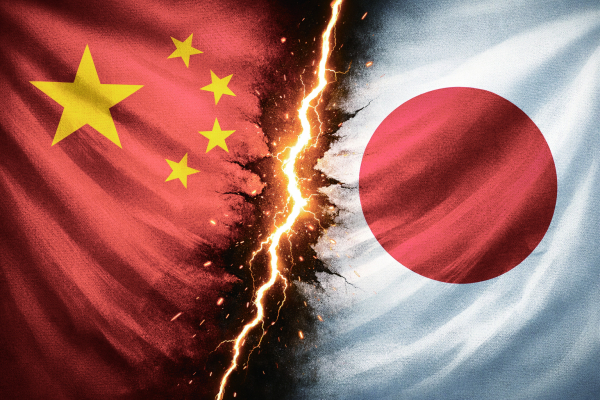
As tensions between China and Japan have recently intensified, the political situation in Northeast Asia has become unstable. The latest conflict was triggered by Japanese Prime Minister Sanae TAKAICHI’s remarks on Nov. 7, 2025. In her speech, she stated that a crisis in Taiwan could be classified as a survival-threatening situation for Japan, justifying the exercise of its right of collective self-defense. China, which is highly sensitive to issues related to Taiwan, reacted immediately. The day after Takaichi’s remarks, the Chinese consul general in Osaka harshly criticized her, saying he would “cut that dirty neck without hesitation.”
China continues its economic and cultural retaliation against Japan. The Chinese government has issued advisories discouraging its citizens from traveling to or studying in Japan. Furthermore, the Chinese government has decided to suspend imports of Japanese seafood, about two weeks after resuming them in early November 2025. Following Takaichi’s remarks, China has also intentionally delayed export approvals of rare earth elements, which are vital for Japan’s semiconductor, electric-vehicle, and defense industries.
Cultural exchanges have also been affected. Performances by Japanese entertainers in China have been canceled one after another. On Nov. 28, 2025, Japanese singer Maki Otsuki was forced to leave the stage during a concert in Shanghai after the lights were suddenly turned off and the music was cut. Additionally, China has suspended the release of Japanese films in China, restricting access to Japanese content.
Some people believe that South Korea could benefit from the conflict between China and Japan. According to the Korea Trade-Investment Promotion Agency office in Tokyo, Chinese tourists turn to South Korea as an alternative destination to Japan, and new opportunities may emerge in Korea’s tourism, aviation, and hotel sectors. However, such “windfall profit” is likely to be short. As tensions between the two countries heighten uncertainty in Northeast Asia, they could also pose risks to South Korea’s financial and foreign-exchange markets. Park Jong-chol, a professor in the Department of Social Studies Education at Gyeongsang National University, noted, “The Trump administration is not taking sides with its ally, Japan. We should take a practical approach centered on national interests.”