

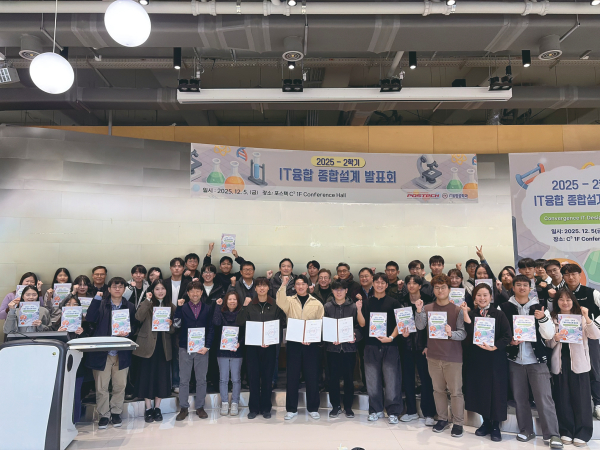
“Convergence IT Design (CITE201 /202/301/302)” is a structured series of project-driven courses designed to prepare students for real-world IT engineering design challenges. The series comprises four consecutive courses, Design I to IV, guiding students through a sequenced learning path that progresses from fundamental skills to advanced applications. Together, these courses embody the core educational philosophy of the Department of Convergence IT Engineering (CiTE), emphasizing integration, creativity, and practical problem-solving.
The series begins with Convergence IT Design I, where students acquire the foundational knowledge required to study, design, and develop creative IT systems. This course offers hands-on training in essential engineering tools, including 3D printing, Arduino development, and CAD tools. Through structured exercises, students build technical literacy and gain confidence in using engineering tools for design rather than as isolated technologies.
Building on this technical foundation, Convergence IT Design II, III, and IV focus on student-driven project development. In these advanced stages, students are no longer guided by predefined problems. Instead, they identify real-world challenges, define their own design goals, and propose innovative solutions. Furthermore, the courses are structured around a highly time-disciplined schedule that emphasizes continuous progress and communication. Students are required to submit weekly progress reports and deliver in-class presentations throughout the semester. In addition to these weekly activities, each course includes two to three formal progress reviews in which students present their project status in greater depth.
The design sequence culminates in “Demo Day,” a public presentation event that serves as the final milestone of the semester. During Demo Day, each student presents their semester project through a five-minute oral presentation, explaining the problem, design approach, and outcomes, followed by a live demonstration of their product, such as a working prototype or a robot. The presentation is followed by a three-minute Q&A session. Demo Day emphasizes not only technical achievement but also the ability to clearly communicate design intent and respond to critical questions from a diverse audience. At the end of Demo Day, the top three student projects are selected and honored.
Convergence IT Design is not simply a sequence of courses, but a long-term design education framework. It aims to cultivate engineers who can independently navigate ambiguity, integrate diverse technologies, and confidently carry a design project from concept to realization. By the end of the series, students acquire not only technical skills but also the mindset and experience necessary to address complex, interdisciplinary problems.
