One of the most startling developments in the global technology landscape in 2025 was the emergence of “DeepSeek Shock.” The release of a large language model (LLM) by DeepSeek, a Chinese AI startup, ignited a new AI race between the U.S. and China. DeepSeek challenged the prevailing success model of U.S. Big Tech by introducing a LLM that is not built on massive capital, and caused shockwaves through the AI-related stock market. As 2026 emerges, the phrase “Made in China” is undergoing a quiet but profound redefinition. No longer confined to manufacturing efficiency, it signals an all-out attack on frontier technology.
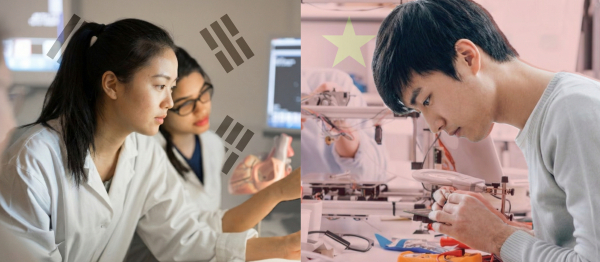
In July 2025, KBS documentary program “Documentary Insight” released a two-part series, “The Talent War,” including “China Obsessed with Engineering” and “Korea Obsessed with Medical School,” which examined how different countries are cultivating STEM talent. As if validating the documentary’s argument, the national college entrance exam, a month ago, recorded the highest proportion of repeat test-takers. Among the 11 students who achieved perfect scores, seven chose medical school.
Why are Korean students heading toward medical school, while Chinese students head for engineering? One reason is that individuals make choices that maximize personal returns. Given the same backgrounds, people choose paths with higher expected returns within existing social structures. In Korea, a doctor’s salary is estimated at roughly six times the GDP per capita, compared to 2.2 times in China. Amid prolonged economic stagnation and growing fears of early retirement, medical professionals offer long-term job security as licensed experts. By contrast, in China, the top 10 highly paid majors for universities are all in engineering fields. As a result, Korea’s top-performing students overwhelmingly aim for “Uichihan”—a Korean abbreviation of medical school, dental school, and oriental medicine school—while China’s elite students focus on “Tsing-Bei Turing Classes”—the computer engineering major at Tsinghua and Peking University.
The divergence is seen not only in education but also in government policy. Talent flows tend to align with policy direction. China’s top ministers are largely composed of science and engineering graduates, and the state has consistently prioritized R&D investment. The Chinese Academy of Sciences (CAS), a national institution under the central government, serves as the country’s advisory and research body in the natural science fields. Scientists in CAS receive the highest treatment and research funds, exerting significant influence over national policy decisions. China’s tech strategy combines domestic cultivation and aggressive attraction of overseas talent. Through initiatives such as the “Thousand Talents Plan,” the government actively sought to recruit engineers abroad. With the new name “Qiming,” it has evolved into a more covert and seductive proposition to scientists in various countries. Recently, approximately two months ago, 149 KAIST researchers received recruitment emails from Chinese institutions, promising an exceptionally high salary and benefits. The Korean government has announced a system to select 20 national scientists annually for five years, which supports an annual research fund of 100 million KRW. However, this is still not a practical incentive. China’s Thousand Talents Plan offers 100 to 500 million KRW for an annual salary to top scientists abroad.
Korea’s research funding system is largely performance-based to prevent the misuse of public research budgets and ensure accountability. While this approach enhances administrative transparency, it has also fostered a research culture increasingly fixated on short-term outcomes and low-risk topics. To break this inertia, the government has promised the largest R&D budget next year. Investment in AI has doubled, basic research area funding increased by 14.6%, and 1.3 trillion KRW for science and engineering talent recruitment, recognizing the strategic importance of science and engineering talent.
The consequence of diverging talent flows is already visible. In China, a deep pool of engineering talent enables rapid advances in global tech industries. DeepSeek is not a coincidence but a structural outcome of talent allocation. In Korea, however, the concentration of top students in medical schools and passive support risk cementing its position as a tech follower. Now, as top engineers increasingly define the global tech race, one question remains: how a nation values its talent will ultimately determine its place within it.