After the hectic midterm exam, a moment arises that puts students in a dilemma. Roughly a week after midterms, students can withdraw from their courses. Also, when final grades are released, some students begin weighing the option of retaking courses. The Postech Times asked if POSTECH’s course withdrawal and retake policies are truly functioning as an effective academic safety net, and whether there might be better ways to ease students’ burdens.
Withdrawal is the process of dropping a course from the period after the course adjustment until the ninth week of the semester. Students usually refer to withdrawal as a “drop.” A drop needs the approval of both the course professor and academic advisor. Withdrawal leaves a “W,” and a retaken course after withdrawal leaves “RW (Repeated after Withdrawal).” A course retake is to enroll again in a course for which a grade has already been disclosed. The grades for retake are capped at B+. After retaking, “R” will remain in the transcript, which notes a repeated course while the original grade is removed.
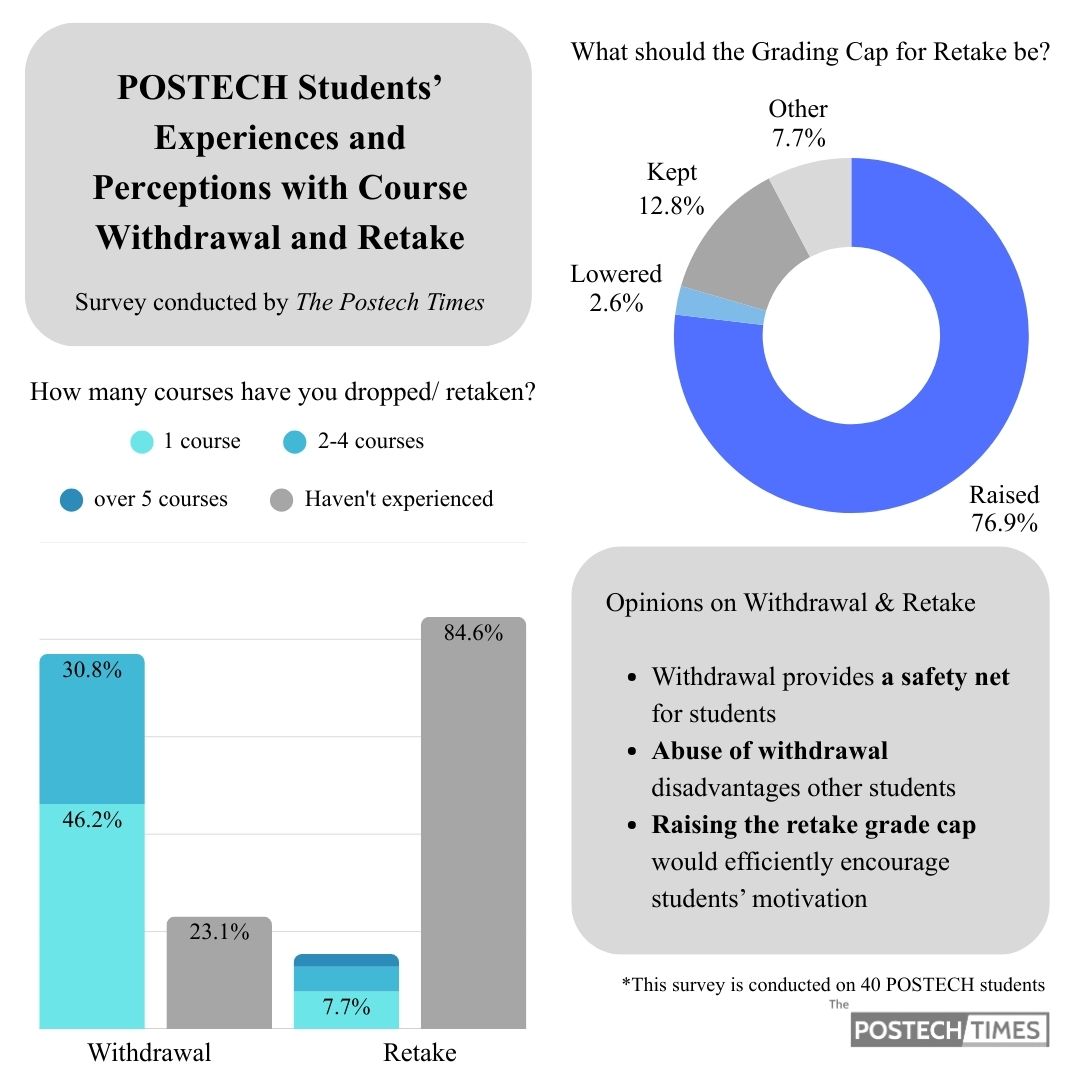
We surveyed 40 POSTECH students to see their perceptions and experiences with the course policies. According to the survey, 77% of respondents reported having used the course withdrawal, and among them, 18.8% cited difficulties with the approval process or the limited withdrawal period. In the same group, only 15.4% had retaken, significantly less than those who had withdrawn from courses. About the grading cap for retaken courses, 76.9% believed that it should be raised, while 12.8% agreed with the current grade limit (B+).
Students also noted that retaking is considered a more diligent approach than withdrawal. However, students hesitate to retake due to the current grade cap—the B+ limit is insufficient to encourage academic incentives. Concerns over disadvantaging other students were minimal; some even pointed out that the prevalence of an unofficial archive of past exams gives retaking students a greater advantage. Most students felt that withdrawing offered a more effective way to manage their GPA than retaking it, supported by the previous survey. As withdrawals have increased, unintended consequences have emerged; for example, higher class averages or recalibrating the number of A+ due to decreased enrollment.
The Postech Times also reached out to both Educational Affairs and Records (EA) and a Muenjae class advisor professor. The EA acknowledged student demands for the grade cap for retake but noted that simply raising it is not straightforward. The primary concern is GPA inflation, which could negatively affect the external reliability of academic performance. According to the Higher Education in Korea (HEIK), the proportion of A+ in major courses at POSTECH ranged from 11% to 20%. While expressing cautions over grade inflation, they announced a plan to conduct an overall review of withdrawal and retake policies in the first half of 2026.
The professor expressed skepticism about using course withdrawals or retakes just to improve GPA, emphasizing that these options should remain as exceptional measures. Also, there were concerns over potential large fluctuations in student numbers and grade inflation. The professor noted that higher grades could sound appealing, but if everyone’s grade rises, underlying issues will remain unsolved. Ultimately, the emphasis should be on the courses students take rather than the grades, highlighting the need to consider the fundamental purpose of university education.