

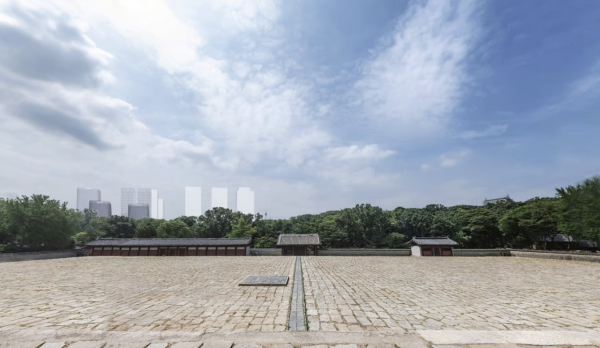
The redevelopment of Sewoon District 4, one of the districts surrounding Jongmyo Shrine, has become a topic of controversy. Seoul City argued that “the deteriorating city cannot be left unattended,” whereas both the Ministry of Culture, Sports, and Tourism and the Korea Heritage Service stated that “high-rise buildings would ruin the view of Jongmyo Shrine, a UNESCO World Heritage Site.”
On Oct. 30, Seoul City announced a redevelopment plan to raise Sewoon District 4’s height restriction from 71.9 meters to 141.9 meters. The plan is to demolish the Sewoon Commercial Complex in front of the shrine, develop Sewoon District 4, and create a park funded by the 1.5 trillion KRW to be gained from the altered height restrictions.
In response, UNESCO sent a formal diplomatic letter to the Korea Heritage Service. According to a briefing by Huh Min, administrator of the Korea Heritage Service, UNESCO recommended that an impact assessment be conducted. UNESCO expressed concern that high-rise construction in Sewoon Districts 2 and 4 would damage Jongmyo Shrine, and said that approval of the project would be suspended until the center and advisory body completes a positive review. Jongmyo Shrine was chosen as a UNESCO World Heritage Site for being the oldest and most well-preserved Confucian shrine in Korea.
On Nov. 20, Seoul City argued that Sewoon District 4 is suitable for redevelopment, as it is 170 meters outside the World Heritage Area and 520 meters away from the Main Hall of Jongmyo Shrine. Sewoon District 4 also lies south of the shrine, which places it mostly out of sight from the Main Hall that faces southwest. Having waited nearly 20 years, locals are requesting that they be able to exercise their legitimate property rights.
While UNESCO’s concerns are valid and must be taken into account, the World Heritage title itself should not be a straitjacket for urban regulation. The solution is a middle ground: adjusting the height limit so that the buildings do not overwhelm the shrine, while building the park as planned. The trade-off between the high-rise buildings and the new park could revitalize the Jongmyo area, turning it into a living landmark that bridges tradition, nature, and modernity.
