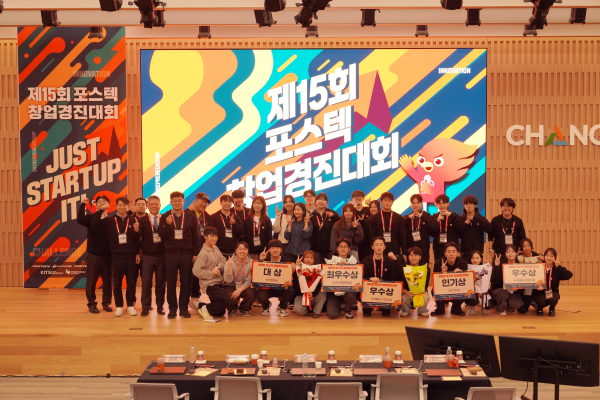
The finals of the 15th POSTECH Startup Competition successfully took place on Nov. 14 at CHANGeUP GROUND. The competition served as a platform to spotlight bold, innovative startup ideas and to strengthen the Gyeongbuk region’s entrepreneurial ecosystem.
19 teams that passed the document screening refined their startup projects over the course of three months through entrepreneurship training, expert mentoring, and technology-protection workshops. Ultimately, 10 teams advanced to the finals—six from POSTECH and four from other universities. This year’s competition showcased a wide range of technology fields, including aerospace, wearable devices, AI, drone robotics, and social platforms.
Postechians were invited to attend the competition as part of the audience and participate in mock investment. The team that received the largest amount of investment was awarded the Popularity Prize, which was later granted to “Griffin Robotics.” Their startup item was a rolling drone utilizing a spherical cage for rapid facility inspection.
Domestic startup experts including Seokwoo Lee, CEO of AutoCrypt and alumnus of POSTECH’s Department of Industrial and Management Engineering, assessed each team’s technological capability and market potential. A total of 20 million KRW in prize money was distributed among award-winning teams, along with follow-up support such as residency opportunities at CHANGeUP GROUND, and actual investment linkage through the POSTECH Holdings University Startup Fund.
The Grand Award was awarded to “BE Space.” The team presented a satellite system designed for space-based experiments and received 10 million KRW in prize money. The Excellence Award went to “REXAR,” which showcased a glove-type wearable device capable of recognizing and transmitting military completion signals. The Merit Awards were presented to teams “MOYA,” for developing a wearable device for menstrual flow detection and replacement alerts for women with disabilities, and “KA,” for introducing a predictive maintenance solution for CNC machining centers.
We interviewed Minsoo Kim (ME 20), team leader of “BE Space”.
Could you introduce your startup item?
The core technology of our startup item is a sample-return mechanism based on Thermal Protection System (TPS). We designed it to protect experimental payloads from the intense heat generated during atmospheric re-entry.
What inspired you to develop your startup item?
Our idea evolved through several pivots. We initially planned to develop deployable structures with origami techniques. However, repeatedly launching and retrieving structures into space seemed very impractical and led us to tackle the problem of safely recovering experimental payloads from space. Such technology is difficult to access for many private research labs, so it seemed like a perfect business idea.
What long-term goals do you hope to achieve through this startup?
We see our technology as a step toward expanding humanity's capability in space. In the future, we hope to support missions such as asteroid mining or to help establish supply chains for rare materials difficult to obtain on Earth.
Even the teams that were not selected for awards demonstrated strong technological capabilities, making this year’s Startup Competition more competitive than ever. The event is expected to help outstanding talent from POSTECH and the Gyeongbuk region turn their ideas into real businesses and grow into promising startups that can lead the local innovation ecosystem.