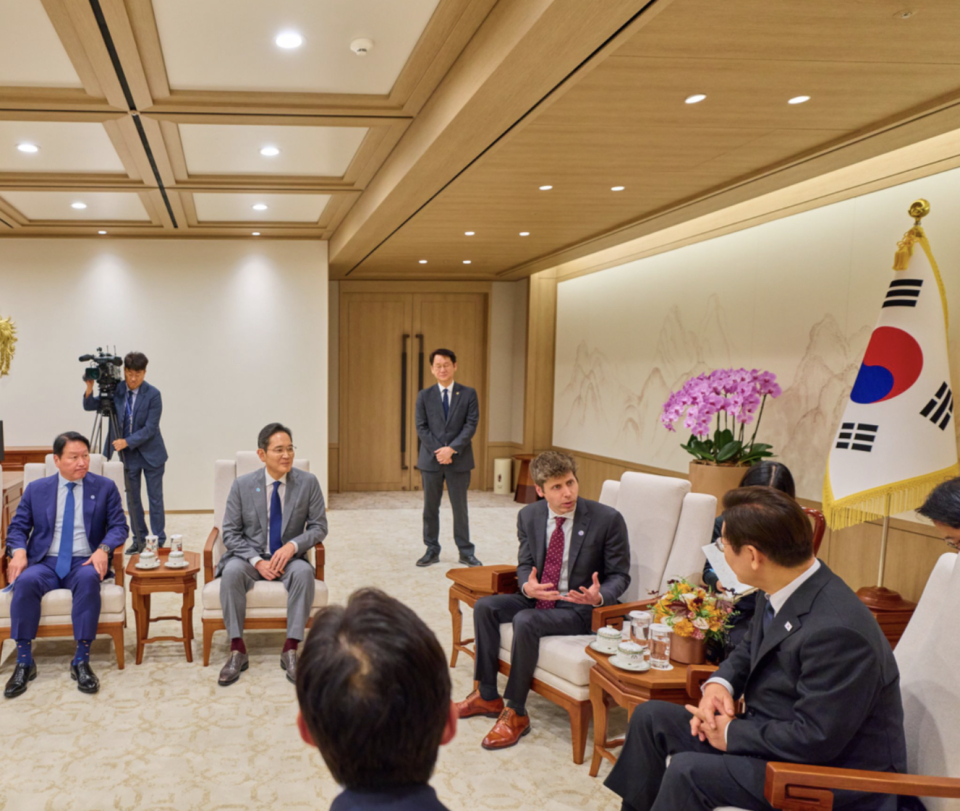
In an effort to build next-generation AI infrastructure, OpenAI is partnering with Samsung Electronics to construct a 20-megawatt (MW) data center in Pohang. The facility marks OpenAI’s first major investment in South Korea, reflecting the nation’s growing role in global AI development and semiconductor technology. The partnership was discussed on Oct. 1, when South Korean President Lee Jae-myung met with OpenAI CEO Sam Altman at the presidential office. Samsung Electronics Chairman Lee Jae-yong and SK Group Chairman Chey Tae-won were also present.
OpenAI announced plans to build and operate two new data centers in Korea in partnership with major Korean companies—specifically, a facility in Pohang with Samsung Electronics and another in South Jeolla Province with SK Group. These data centers will be the integral components of OpenAI’s “Stargate Project,” a global initiative valued at 700 trillion KRW to build cutting-edge computing infrastructure capable of supporting the training, deployment, and scaling of artificial intelligence models. The primary objective of the Stargate Project is to address the rapidly increasing demand for high-performance computational resources, thereby facilitating global advances in AI research and application.
An AI data center is a specialized facility that provides the computing infrastructure required to train and operate artificial intelligence systems. Designed for high-performance computing, these data centers handle the resource-intensive training of complex learning models and consume vast amounts of energy to power advanced Graphics Processing Units (GPUs) and Tensor Processing Units (TPUs), along with sophisticated storage, networking, and cooling systems.
OpenAI reportedly chose Pohang following a strong recommendation from Park Sung Bin, the sucessor to Park Tae-joon, founder of POSTECH and POSCO. Pohang offers ideal conditions for hosting a data center, serving as a major cluster of Korea’s steel and secondary battery industries. The constant flow of electrical energy required to run the data center is possible with the Uljin nuclear power plant, and 120 MW of electricity can be supplied on demand by the West Pohang Electrical Substation as well. Another distinctive advantage of Pohang is POSTECH’s talent pool and research-based facilities; world-class research facilities, paired with scientific talent, can generate massive, complex datasets across various scientific fields. This can give the data center potential to grow into a strategic research hub.
The data center will be built in the Pohang Fusion Tech District in Heunghae-eup, Buk-gu, Pohang city. It will initially operate with a capacity of approximately 20 to 40 MW, with potential for future expansion. The facility is expected to become a cornerstone of OpenAI’s infrastructure in Asia, providing high-performance computing resources essential for training and deploying advanced AI systems. The first phase is scheduled for completion in December 2026, with operations to begin in January 2027.
This initiative is part of a broader strategy to transform the nation into the world’s most advanced AI testbed, as South Korea aims to establish itself as a global leader in artificial intelligence infrastructure. The development will represent a significant turning point for Pohang, expanding its role beyond the steel industry and positioning it as a central hub for emerging industries and global innovation. Pohang City expects the data center to attract related companies and startups, thereby fostering an AI ecosystem that drives innovation across industries.