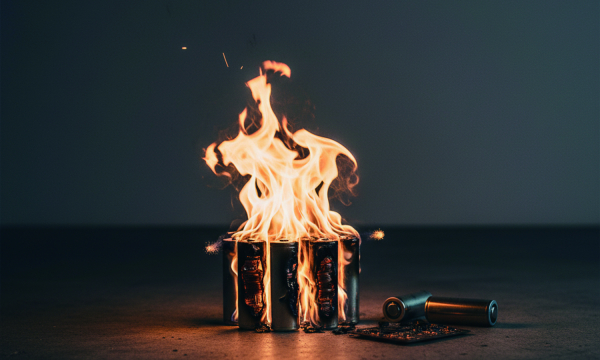
On Sept. 27, a fire broke out at the Korean government’s computer system headquarters, the National Information Resources Service Center (NIRS). This caused permanent data loss, without any backup storage of crucial national information. The fire broke out during the improper demolition of the battery. The firefighting process took considerable time since 380 battery packs had to be moved into water tanks. The NIRS fire brought longstanding concerns over battery safety back into the spotlight.
There are various kinds of batteries; most commercialized are lithium-ion (Li-ion) batteries. The Li-ion battery is a rechargeable battery that converts oxidation-reduction reaction to electricity. The Li-ion battery comprises a cathode, an anode, an electrolyte, and a separator. Anode and cathode are electrodes that exchange Li ions. The electrolyte is a medium that helps ions move between two electrodes. The separator prevents contact between the anode and the cathode, which can cause a disastrous fire. If the anode and cathode are too close to make contact, a huge current flows directly into the anode, accompanied by rapid heating. The huge thermal energy decomposes the electrolyte and accelerates the combustion of the whole battery, also known as “Thermal runaway.”
Thermal runaway is the biggest threat to Li-ion battery safety. The loss of control to internal chemical reactions can cause the battery’s temperature to exceed 1000°C within seconds. It could also include an explosion or a vapor cloud with high toxicity. Once it begins, conventional firefighting methods are ineffective; most end only after every flammable material turns to ash. The most effective way is to cool down the battery with a large volume of water. The metal inside the battery, such as aluminum, iron, or copper, reacts with water at high temperatures by thermal runaway; simply spreading water can increase the risk of explosions.
Li-ion batteries also face drawbacks, including difficulties in recycling and gradual degradation over time. Only 5% of Li-ion batteries are recycled around the world. Recycling demands a higher cost than mining new Lithium metals. Furthermore, the lifespan of a Li-ion battery depends on its application and usage patterns, with performance degradation accelerating after around 400 charge-discharge cycles. This raises the risk of battery fire and possibly leads to thermal runaway.
Focusing on the drawbacks of the Li-ion battery, there were some efforts to develop alternative batteries. A solid-state battery (SSB) uses solid electrolytes that serve as both the electrolyte and the separator. Replacing inflammable liquid phase electrolytes with nonflammable solid materials can prevent thermal runaway efficiently. It can handle a broader thermal spectrum and achieve high energy density. This is why SSB is also known as a “dream battery.” However, key challenges still lie ahead. Low ionic conductivity and high interfacial resistance are the remaining tasks. Nonetheless, domestic companies such as POSCO, LG Energy Solution, and Samsung SDI continue to pursue research on SSB.
There have also been technologies enhancing the safety of the Li-ion battery itself. In Sept. 2024, Nature Communications reported the development of a new material capable of suppressing thermal runaway. The key breakthrough was building a safety-reinforced layer (SRL) on the current collectors. The SRL can act like a “fuse,” which reacts to temperature rises beyond normal levels by increasing resistance and limiting the current. The key advantage of this technology is that it can effectively prevent thermal runaway within practical production environments, without degrading the performance of conventional Li-ion batteries.
Extending the lifespan of batteries has also emerged as a major focus of ongoing research. Researchers are using organic surfactants in the synthesis to embed valid molecules on the cathode surface. This increases the strength of the cathode, preventing the collision of the battery’s inner structure during the charge-discharge cycle. For the anode, the use of silica, though it still has remaining challenges, is being actively studied to increase both battery lifespan and capacity. As the Li-ion battery industry, the foothold of the high-tech industry, is consistently undergoing studies. Now, all eyes are on how they build more sustainable and safer batteries.