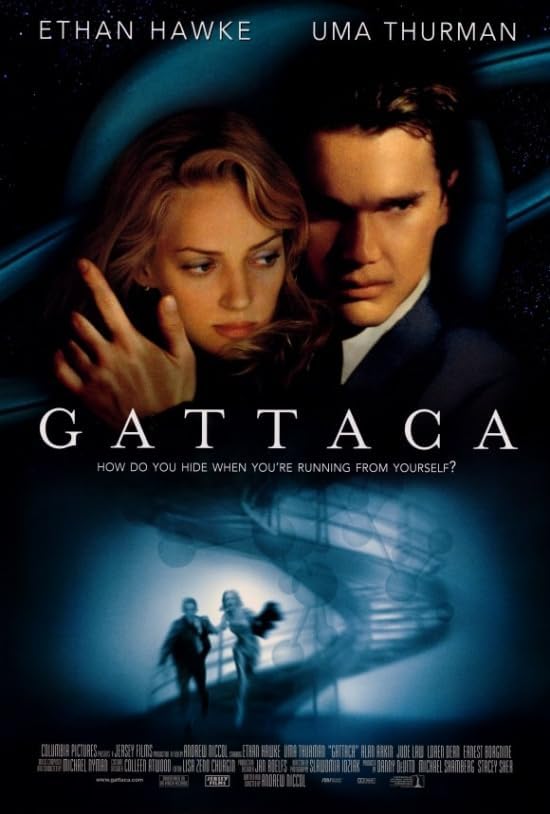
Andrew Niccol / Columbia Pictures and Jersey Films
It is hard not to feel a sense of envy when you see someone being naturally talented—especially when they perform better than you. Some people are born healthier, smarter, stronger; sometimes it might even feel like they were born “better.”
In the dystopian world of Gattaca, it is “natural” to be born this way, thanks to the power of genetic engineering. Humans are divided into two social classes; Valids, the genetically modified-and-optimized, and In-Valids, born through maternal birth. Quite evident from their names, Valids are treated as superior, often passing any social hardships with flying colors, and competing with other Valids to be the very best, while the In-Valids take care of the more monotonous or strenuous jobs.
Vincent Freeman is one such In-Valid, and the plot of the movie follows him chasing his dream of becoming an astronaut at the Gattaca Aerospace Corporation despite his eugenic shortcomings.
When Vincent is born, his blood is immediately sampled and tested. The doctors are quick and cold to tell his parents: “nerve condition–probability sixty percent. Manic depression–probability forty-two percent. … Heart disorder–ninety-nine percent–early fatal potential. Life expectancy–thirty-three years.” Perhaps it is the expected defect of human nature.
On the contrary, when Vincent’s brother is being genetically engineered, the doctor states that their second child will be “simply the best of [them].” He is born healthier, smarter, and stronger than his older brother.
As the plot progresses, it dissolves down to one clear question: are we defined by our genetic makeup, or can the human spirit triumph over “predetermined” limitations? Can human spirit overcome destiny? In a world that screams “No,” Vincent successfully throws off his genetically superior supervisors and pursuers to achieve his dream of reaching the stars.
Vincent’s struggle is a testament to the power of not just ambition, but painstaking determination. To pass as a Valid, he must endure a daily regimen of scrubbing away his own identity, quite literally. He spends each morning scrubbing at his skin to prevent any microscopic sliver of dead skin from shedding itself and leaving a genetic trace to his original identity. He then meticulously plants borrowed genetic material in place—skin, hair, urine, and blood—from his benefactor, Jerome Morrow.
Jerome, a paralyzed former swimming star, is the tragic flip side to Vincent’s success. He is a Valid who was genetically perfect but couldn’t handle the pressure of anything less than first place, lamenting, “Jerome Morrow was never meant to be one step down on the podium.” He provides Vincent the genetic material—the “borrowed ladder”—to succeed, finding a new purpose for life through Vincent’s impossible dream.
Gattaca is a defining example of a science-fiction-meets-film-noir. The film masterfully explores Vincent Freeman, impersonating a eugenically perfect Valid, as investigators chase him as both an impostor In-Valid at Gattaca and a prime murder suspect. The world of Gattaca is sterile and minimalist, with a retro-furturistic—retro even for 1997—aesthetic that feels both satisfyingly juxtaposed and cleanly delivered.
In today’s perfection-driven society, Gattaca still resonates—not only as a warning about genetics, but about ambition and human worth. It reminds us that true achievement is not born solely from perfection and determined dice rolls. Gattaca suggests that, as corny as it may sound, perhaps determination is what truly decides one’s success.