

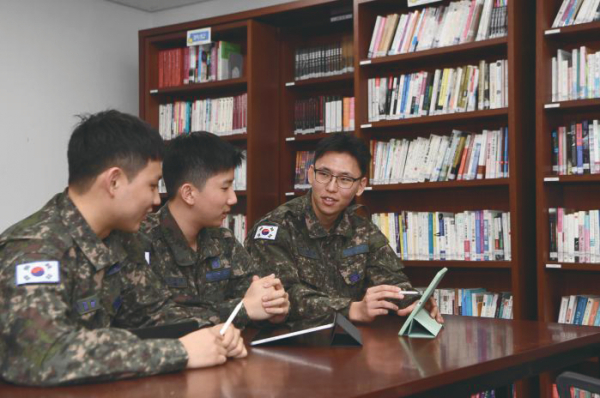
Article 39 of the Constitution of the Republic of Korea states: “All citizens shall have the duty of national defense under the conditions as prescribed by Act. No citizen shall be treated unfavorably on account of the fulfillment of his obligation of military service.”
Military service often creates one of the largest interruptions in a student’s academic path. In response, many universities have introduced military e-learning programs, designed to allow students to continue their studies remotely while serving. POSTECH adopted such a system in the fall semester of 2021, yet student testimonies and administrative responses suggest that the program’s operation still faces substantial limitations.
According to the Office of Academic Affairs, the program was established in line with the request from the Ministry of National Defense to reduce the academic gap caused by mandatory service. Students can enroll in selected online or hybrid courses each semester, with credits recognized up to six per semester and twenty-four during the entire service period. Courses are taken via PLMS in an audit format and later recorded as seasonal semester credits.
From the students’ perspective, the benefits are evident. A senior computer science student reported that completing a liberal arts course during service helped reduce post-return burdens, allowing more focus on demanding major requirements. For many, the simple fact that the two-year service period does not have to remain an academic void is a meaningful gain.
Nonetheless, challenges exist. POSTECH’s Academic Affairs Team notes the unpredictability of military schedules, limited internet access, and the extra administrative work imposed on instructors. Professors, in particular, have expressed concerns about managing separate schedules for enlisted students and questioned whether rigorous coursework could be effectively delivered under such circumstances. As a result, expanding the program is approached cautiously.
Students, however, view the issue differently. One student emphasized that “the number of courses is far too limited, with most capped at fewer than ten seats.” He further argued that concerns about teaching quality and management are exaggerated, citing the university’s successful transition to online education during the pandemic. Other suggestions included offering courses under a pass/fail system or creating separate course codes to ease the workload and address concerns about fairness. Unfortunately, students argue that despite repeated discussions, no tangible improvement has been observed.
This debate reflects a broader issue: while students are compelled to serve, the lack of meaningful academic support signals neglect. Those who surrender two crucial years to duty face an academic void, suggesting that their sacrifice is demanded, yet their future is undervalued.
POSTECH has pledged to expand online and hybrid offerings and provide clearer guidelines to instructors to stabilize the program. Yet its success will ultimately depend on whether students can genuinely benefit. To prevent military service from derailing education, the university community—including administrators, professors, and staff—must work collectively to ensure continuity as a matter of principle. Ensuring educational progress is not only an institutional responsibility but also a fulfillment of the constitutional promise of fair treatment. Therefore, military e-learning is more than an administrative tool; it measures the entire university’s commitment to the rights and futures of those who serve.
