Everyone has their own place in society, but South Korean men share a common duty of national defense and a mandatory period of military service. Postechians are no exception, but rather than serving as regular soldiers, there are alternative ways that allow outstanding science and engineering students to serve by applying their talents in research.
Technical Research Personnel (TRP)
For science and engineering students, the Technical Research Personnel (TRP) program is the most common alternative military service system, providing qualified individuals with the opportunity to continue their research. With its purpose of contributing to the growth of national R&D projects, those selected as TRP carry out their service as research agents at designated companies or institutes. Unlike conventional military life confined to the military units, TRP participants commute to work and are able to enjoy the same range of daily activities as regular citizens, which is a major advantage as well.
However, unlike the standard service term of 18 months in the Army and 21 months in the Air Force, TRP participants must complete 36 months of service before discharge. This extended service period is the main deterrent for many students, particularly those planning to pursue graduate studies abroad. There is also uncertainty in the selection process: if not selected, one risks postponing military service until a later age, which can significantly disrupt one’s career. Students weigh both factors and decide whether they value a shorter service period or an uninterrupted academic life.
Research Officers for National Defense (ROND)
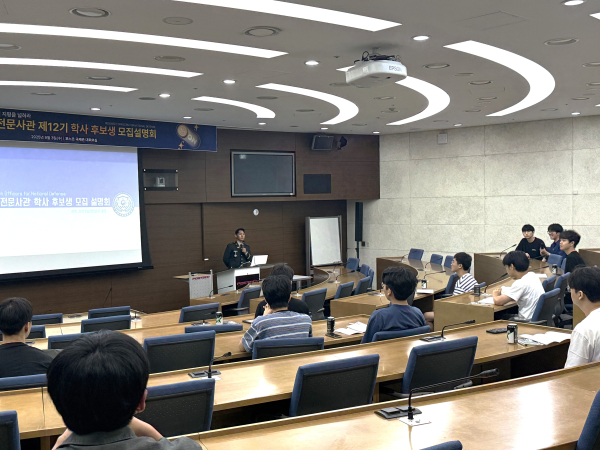
Research Officers for National Defense (ROND) is another military service route for STEM major students. Modeled after Israel’s elite science and technology officer program, “Talpiot,” ROND selects outstanding undergraduate students and enables them to engage in research in the field of defense science and technology. Participants work as researchers in the Agency for Defense Development (ADD) during their period of service, which is also 36 months.
A distinctive feature of the ROND program is its selective, small-cohort recruitment. Although the intake quota differs for each field, the total number of candidates is limited to between 20 and 25. Recruitment takes place every year from September to December, and eligible applicants are science and engineering students enrolled in their fourth or fifth semester. Applicants are first selected as candidates and must obtain their bachelor’s degree within a set period after selection in order to be formally commissioned and begin their service. Competition is fierce, but the program remains highly popular as it offers the opportunity to collaborate with many top-tier researchers.
We interviewed Sunghyun Jo (CiTE 22), a candidate for the 10th class of ROND. “I hope students won’t be discouraged from applying because their interests are not directly related to defense, as flexible research is allowed in diverse fields. Three years of working with talented peers and mentors will be an invaluable experience.” He also emphasized that GPA is not the sole criterion for selection, so it is important to highlight one’s strengths through activities such as UGRP, ideathons, or research participation.
While military service is often seen as a burden, it can also serve as an opportunity to explore various paths and leverage the experience for a future career. Carefully choosing a route that aligns with personal goals and circumstances will allow one to continue moving forward in any situation.