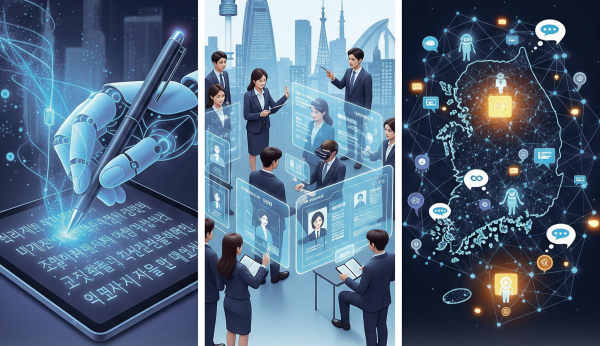
A recent directive from the Ministry of Education has sent shockwaves through South Korea’s schools. The notice stated that while narrative sections of student records must be based on teachers’ direct observation and evaluation, they may use generative AI such as ChatGPT as a supplementary tool for editing. However, it firmly stressed that teachers will bear full responsibility if false or exaggerated information is discovered later.
Teachers say using generative AI like ChatGPT to draft student records has already become an “open secret.” With the high school credit system fragmenting evaluation and administrative work, teachers now must write subject-by-subject records every semester rather than once a year. Many have therefore turned to AI subscriptions as part of their routine. Start-ups advertising “AI trained on 30 million characters of Seoul National University student records” underscore hw widespread this trend has become. Yet because student records remain crucial in college admissions, how to verify entries drafted or polished by ChatGPT is still an open question. “Ultimately we have no choice but to trust what teachers submit,” said one private university admissions officer. “The best we can hope for is that they provide reliable records.” A ministry official also warned that including content unrelated to a student’s actual performance “could be considered false reporting” and urged extra caution.
The job market has not escaped AI’s wave either. As soon as a job posting goes up, applicants now open ChatGPT, Google Gemini, and other AI programs to produce first drafts of their personal statements. Rather than writing from scratch, they edit AI-suggested drafts and cross-check them before submission. “I feel I have no choice but to use it or risk falling behind, but I can’t shake off a sense of unease,” one college student admitted. “AI interview study groups” have also emerged where participants give each other feedback on eye contact and facial expressions. Employers, for their part, complain that while AI-generated applications read smoothly, they are often formulaic or contain fabricated details. Many now dock points or reject applicants outright if AI use is detected. At the same time, companies themselves are rushing to adopt AI interviews and aptitude tests to efficiently sift through hundreds or thousands of candidates. The result is a paradoxical job market where “job seekers prepare with AI and companies screen with AI”—both sides rely on the technology; but neither fully trusts it. Experts caution that because AI’s judgments are not yet scientifically foolproof, sensitive decisions still need to be double-checked by humans.
Keeping pace with this trend, South Korea’s largest platform company, Kakao, is stepping up its AI strategy. In July the firm rolled out “AI Mate Local,” an AI-powered location recommendation service on Kakao Map, and soon after revealed plans to embed ChatGPT into KakaoTalk chats. These moves mark a deliberate effort to weave AI into the routines of everyday life. Company executives openly say their goal is to evolve from a “lifestyle platform” into an “AI-based life companion.”
Kakao’s push reflects a global trend in which major tech players are infusing generative AI and chatbots into search, shopping, maps, and messaging. By adding AI-driven recommendations to Kakao Map and bringing GPT capabilities to KakaoTalk, Kakao hopes to strengthen its edge in the services Koreans use most. Analysts predict that a GPT-enabled KakaoTalk could transform how people compose messages, search for information within chats and even automate routine customer-service interactions.
But the expansion also raises thorny issues. Privacy advocates warn that building large-scale AI into a messaging app used by virtually every Korean could heighten risks around data security and misuse of personal information. Others stress the need for safeguards against hallucinations and errors, and for user education to prevent over-reliance on AI suggestions. “Convenience is appealing, but transparency and control are essential if users are to trust AI woven into their daily communications,” said a tech-ethics researcher.
Kakao’s moves illustrate how AI is no longer confined to labs or niche apps but is steadily reshaping the daily life of many. After Kakao Map and Kakao Talk, observers expect the company to extend AI into finance, shopping, and mobility, repositioning itself as an “AI-based life partner” rather than a simple platform provider. AI spreads from classrooms to job markets to smartphones, the same questions keep echoing: Who is accountable, how is trust built, and how can humans remain in control?