

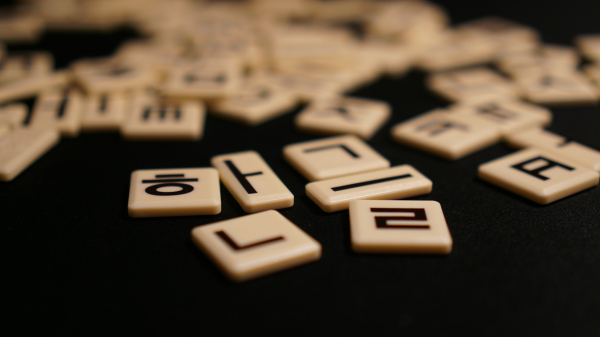
In celebration of Hangul Day 2025 (Oct. 9)
Hangul is the modern Korean writing system, serving as the official script for the Korean language in both North and South Korea. It originates from Sejong the Great, the fourth king of the Joseon Dynasty, who worked with his scholars to create and spread a new script designed for his subjects. During Sept. 1446, he published the new script in a document titled Hunminjeongum, which roughly translates to the “Proper Sounds for the Instruction of the People.” Unlike many writing systems that emerged organically over centuries, such as many Latin-based languages, Hangul was a deliberate invention, created to be as intuitive, accessible, and legible even to those who lack higher education.
While it is a writing system over five hundred years old, Hangul shows a particularly strong stance in the digital world of today. Hangul is an alphabetic syllabary—a system where a symbol represents a whole syllable, constructed from underlying consonants and vowels. Each letter represents an individual sound, and is grouped into consonant-vowel units to form each symbol. This structure is fundamentally different from that of Chinese characters, which have a logographic quality of representing a word or concept with each symbol, making the writing system very powerful and compact, but also making the character set too large and complex for many to learn. Hangul, even in its early form, was uniquely suited for easy learning.
Another benefit of the alphabetic syllabary system comes in the efficiency. Hangul is efficient in relaying information, capable of packing a significant amount of phonetic data into a compact visual space. For example, the romanized Korean word for “chocolate” is “초콜릿”; the difference in length is easily noticeable. This data density means more information can be displayed or presented at once, a crucial advantage for many user interfaces in small, mobile devices and uncluttered layouts in web design.
Yet another strength of Hangul lies in the typing speed. The standard Korean keyboard, known as the 2-set type, cleverly places the consonants on the left side and vowels to the right. This layout promotes a natural and rhythmic flow of typing, with each hand alternating to type out each symbol. Furthermore, for mobile devices, a different layout named “Cheonjiin” is dominant. This system allows the user to type all 10 basic vowels and 11 more complex vowels using only three keys, by deconstructing each vowel into a dot, a horizontal line, and a vertical line. For instance, the vowel “ㅒ” would be constructed linearly by typing the vertical line “ㅣ,” followed by the dot “ㆍ” twice, then another vertical line. Perhaps this system is what makes Koreans consistently rank among the fastest typists in the world.
Hangul is a system representative of both the past and the future. What began as a 15th-century project for mass literacy has proven to be an exceptionally robust and elegant solution for the challenges of the 21st-century digital world. Its scientific design, information density, and compositional nature make it a model of efficiency that very few other writing systems can match. It stands as a testament to the power of thoughtful, human-centered design. Perhaps our audience reading this in English may take this chance to learn Hangul and experience firsthand the simple brilliance of this remarkable alphabet.
