

On Sept. 23, Apple Manufacturing R&D Accelerator hosted the Smart Manufacturing Forum at POSCO International Center. The atmosphere was vibrating with enthusiasm, and attendees from diverse backgrounds—including POSTECH students, faculty members, and industry professionals—filled the hall. Insightful seminars introduced the latest trends in manufacturing technology, including robotics, artificial intelligence (AI), and digital twins.
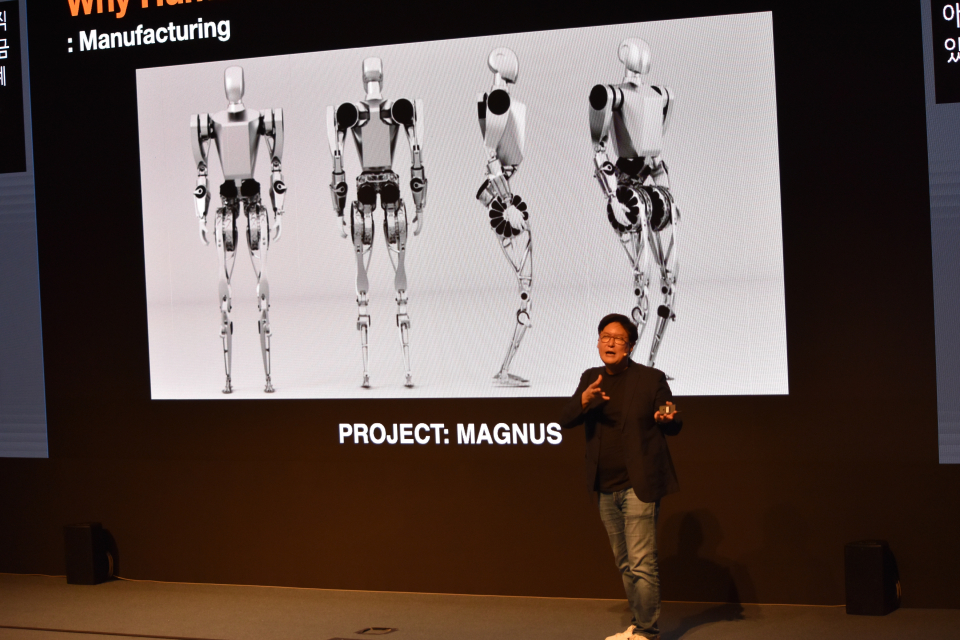
Professor Dennis Hong of UCLA showcased humanoid robotics that will play a major role in smart manufacturing. With their ability to seamlessly integrate into infrastructure designed for humans and their capacity to be deployed in hazardous environments, Prof. Hong emphasized that humanoid robots are versatile, multi-purpose coworkers for diverse manufacturing operations.
He also highlighted that while humanoids are excellent multitaskers, there are more creative approaches for making robots specialized in a single task. One example was the Latching Intelligent Modular Mobility System (LIMMS), an appendage-like robot for delivery. By attaching themselves to a single package, multiple LIMMS collectively behave as legs of a single robot with the box itself as the body. “Form follows function. We must think outside the box and not limit ourselves to conventional solutions.” Prof. Hong explained, mentioning the limitless capability of creative engineers.
Byungseung Lee, the Head of the DX Group at LG Display, outlined the company’s progress and vision for an AX (AI transformation)-driven future. Display manufacturing requires advanced microfabrication processes, which are difficult to perform manually with precision. Such tasks, for example anomaly detection, are now handled by vision AI, which identifies specific processes and equipment where anomalies likely occurred and provides that data to engineers in real time.
The role of AI has expanded into design as well. The current method is known as parametric design, where engineers input multiple parameters, such as the width of a certain layer, to create 3D models of individual components. These components are then arranged to form a printed circuit board (PCB). AI models used in production are currently capable of learning the data associated with these parameters and can take over design tasks far more quickly.
Keunseob Choi, the Head of the Data & Information Technology at Samsung Display, explained the prospective usage of digital twins for an autonomous factory. A digital twin is a virtual representation of a physical object or system that can be utilized to simulate and predict its performance based on machine learning. For example, logistics twins can be used to achieve optimal production scheduling. Manufacturing systems implemented with discrete event simulations are already in use, enabling a logistics navigator to predict congestion points during equipment transport and determine optimal routes in real time. Production twins forecast production capacity to detect and prevent bottlenecks, and the prospect of an organic, autonomously operating manufacturing system appears within reach, with such systems already in use.
While technological alternatives to human labor are advancing quickly, machines can only suggest optimal conditions based on existing designs and have limitations in proposing entirely new, innovative approaches. Participating in this forum was not only an opportunity to experience the frontier of smart manufacturing, but also a sobering reminder that engineers would have to dare to be different and question conventional boundaries to drive the next wave of innovation.
