A Korean research team has developed a breakthrough technology that can dramatically extend the lifespan of lithium-ion batteries. Led by Professor Changshin Jo (CE, GIFT), Jiwoong Oh (GIFT Ph.D. Candidate), and the team of Professor Songhun Yoon (CAU), the researchers developed a new cathode material that enhances durability over five times. This research has been published in the international materials science journal Materials Today.
As electric vehicles (EVs) become more common, battery durability has become critical. Although powerful batteries are needed, existing materials have encountered limitations. “Co-free high-Ni material” is economically preferred, yet is hard to use for the long term. This limitation is comparable to a sports car with a powerful engine that frequently encounters mechanical problems.
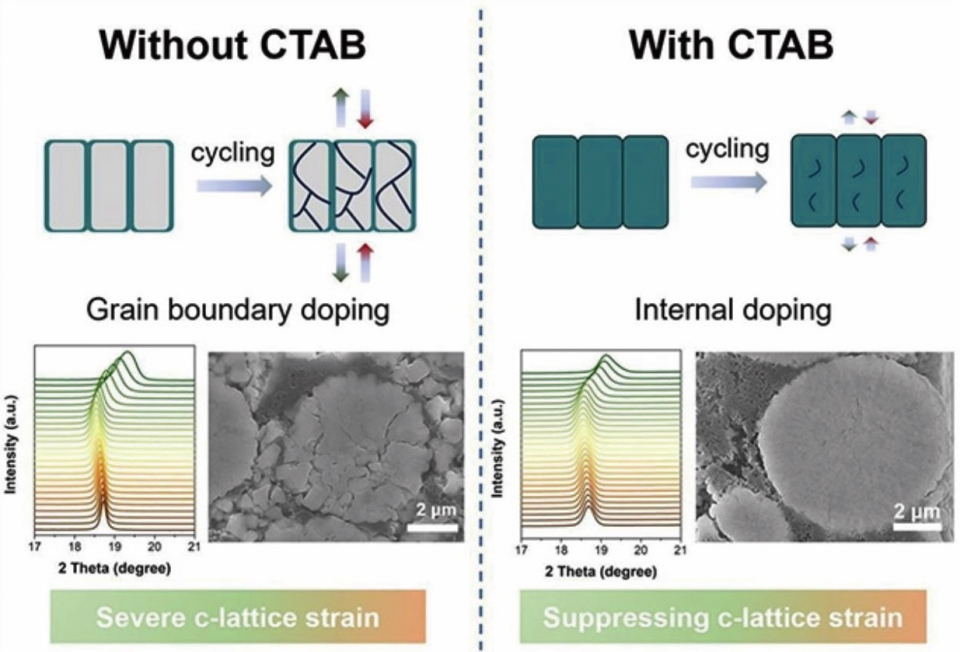
The research team focused on the fundamental driving factor that shortens battery lifespan. Repeated charging and discharging gradually deconstruct the internal structure. As the inner atomic structure distorts and small niches form, the entire structure is damaged. This phenomenon, “c-lattice distortion,” is the key driver of lifespan degradation.
The team developed a new synthesis method using “organic surfactants.” The main approach involved uniformly diffusing Zirconium (Zr) ions into even the smallest cathode particles, as organic surfactants help mix incompatible components—much like oil and water. Also, during the heat treatment process, it firmly embeds the Zr ion in the particle by the carbon reduction effect.
As a result, the cathode material becomes strong, like embedding steel frameworks in a building. The Zr ions act as pillars within the battery’s crystal structure, supporting the structure against collapsing from repeated charge-discharge cycles. The experiment also fully supports the material’s advantage. It maintained 98.6% of capacity after 100 charge-discharge cycles and performed at 94.2% efficiency after 500 cycles. This is a significant enhancement of battery lifespan, which is five times longer than that of the original Co-free high-Ni material.
Prof. Jo explained, “This technology offers a new pathway for developing next-generation cathodes that operate stably without expensive Co. It will enhance the competitiveness of the domestic EV battery material industry.”
This research was supported by the Outstanding Young Researcher Program of the National Research Foundation of Korea (NRF), the R&D program of Korea Institute of Energy Technology Evaluation and Planning (KETEP), and the Battery Specialized Graduate School program of Korea Institute for Advancement of Technology (KIAT).