Most robots derive strength from rigid metallic structures, but this comes at the cost of precision and maneuverability. Until now, there hasn’t been a technology that has combined both flexibility and strength.
To overcome this limitation, a research team led by Professor Keehoon Kim (ME), Prof. Wan Kyun Chung (ME), and Dr. Hyung Gon Shin of Future Robotics Office, Samsung Electronics (formerly of ME) developed a robot skin actuator (RSA) that is as thin as paper, as flexible as human muscles, and can exert great force.
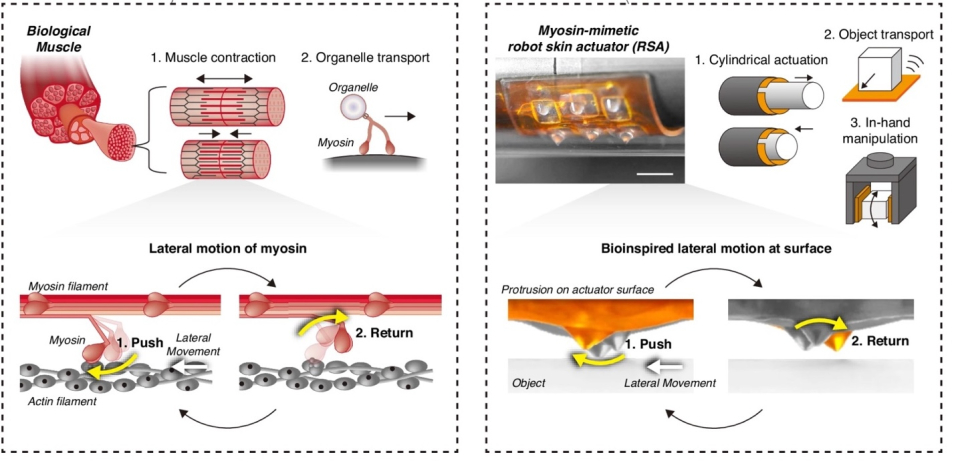
The RSA was inspired by the muscle protein “myosin.” The team observed how myosin repeats small forces to make big movements and made it into a thin sheet-like robot actuator. It has three distinctive features: an array of bumps on the surface, thin air chambers overlapping within multiple layers of sheets, and a multichannel circuit embedded in a thin, flexible body. It is only about 1.5 millimeters thick and contains dozens of tiny air pockets connected by multi-channel airways. The components inside the RSA are interconnected to form a complex three-dimensional network.
When air is injected, the input pressure makes the bumps move in various directions, accumulating small forces that result in significant movements. Each bump is controlled by two overlapping chambers, enabling six types of motion. The shape of the trajectory is determined by the degree of overlap between the chambers and the height of the bump.
The research team validated the technology’s performance through multiple experiments. In object manipulation tests, it moved with precision comparable to human fingers, and it successfully transferred objects in underwater tests. The robot could also move in a bent position by only using the bumps. These results show the actuator’s versatility across manipulation, locomotion, and submerged operation.
Prof. Kim emphasized the significance of the work, stating, “we were able to integrate a complex three-dimensional pneumatic network within a thin and soft structure, and realize multi-directional motion through a bio-inspired approach.” He added, “we expect this technology to be applied in various fields, including surgery robots, industry collaborative robots, and exploration robots.”
This research was supported by the Leading Research Center Program of the National Research Foundation of Korea (NRF), funded by the Korea government, and by the Industrial Technology Alchemist Project of the Ministry of Trade, Industry and Energy (MOTIE).