

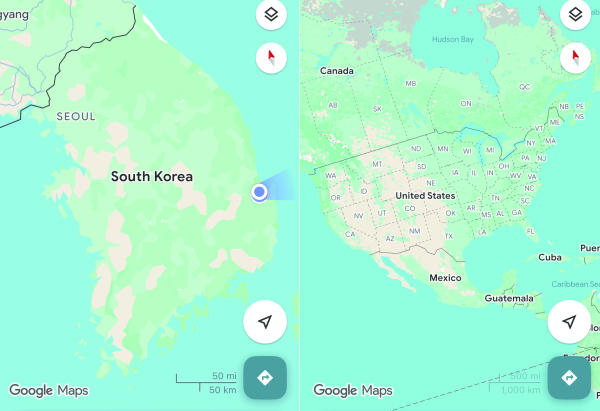
The issue concerning high-definition map (HD map) data has gained a lot of public attention once again, as the Trump administration renegotiates trade agreements with countries worldwide. Since 2007, Google has been requesting map data from the Korean government, but the government has rejected its request for security reasons. The latest request from Google was in February and, after a delay in May, was expected to be addressed in the recent Korea-U.S. trade negotiations. However, the issue remains undecided, while the Korean government has postponed its decision once again.
While commonly referred to as “HD map data,” the map information that Google has asked for is a digital topographic map on a scale of 1:5,000 produced by the National Geographic Information Institute (NGII), and is officially called the National Base Map. Cris Turner, the global head of Knowledge & Information Products, Government Affairs & Public Policy at Google, claims that the company needs to export map data outside of Korea to provide navigation services. He explains that the navigation services require a complex process of calculating the optimal route from one place to another, and therefore need a massive computing power that is spread all around the world.
Those who evaluate the exportation favorably claim that the launch of Google Maps’ navigation services would enhance the availability of navigation services for tourists in Korea and further increase the tourism accessibility of the country. The biggest concern, however, is the security issues. Since such a map is large-scale and includes detailed geographic information, many worry that it could reveal some critical information on important national facilities. This is regarded as a serious issue, especially since Korea is still in the state of ceasefire. The government came up with a compromise in which they asked Google to obscure security facilities on satellite images, delete detailed map coordinates, and install a domestic data center, but Google has only accepted part of these conditions. On the other hand, Apple, which has also asked for the National Base Map, has accepted the conditions and appears to have made more progress in negotiations with the Korean government compared to Google.
While the issue has not been settled yet, making a mutual understanding seems to be the key in working the matter out.
