In the 1960s, Pohang Iron & Steel Company (now POSCO) was founded, and Pohang became a hub of the Korean steel industry. It has led the economic growth and industrialization of Korea, and as of today, the steel industry plays a pivotal role in the economy of Pohang. While a dominant industry implies the substantial scale of its economy, it could also mean that when the industry struggles, the entire economy is affected.
The steel industry is now suffering: the recent Korea-U.S. tariff negotiation has put a serious burden on steel companies. Excess supply of steel and the emergence of low-price steel materials from China further escalated the problem. However, Pohang has experienced similar setbacks before. The city has learned that developing other industries is important during such periods, and has been investing in new industries, such as battery materials. These industries have now grown and contributed to the economy of the city. The city further pays attention to the future industries. Instead of depending on a single industry, the city of steel is now paving its path in diverse fields.
More specifically, Pohang is investing in science and technology, along with the tourism industry. According to Pohang City, its major initiatives aim to develop the fields of batteries, AI & Big Data, biotechnology, food technology, tourism, and more. They are working on improving infrastructure for research; attracting companies and institutions; and setting up additional facilities. These include initiatives to organize a bio-cluster, to estabilish research centers such as the Open Innovation Centers for Secondary Batteries, and so on.
In one of its current initiatives, Pohang City is aiming to establish a global AI computing center. Its plan is to start the construction this year and complete it by 2027. The city is ultimately planning to make the computing center a global AI hub with 1GW-class high-performance AI computing infrastructure through expansion. Pohang City has signed MOUs with domestic and international AI corporations, investment companies, and universities to establish the center in June, and has been working on working-level issues. It is expected that the center will help bring AI into different fields of science and technology and make Pohang a leading city of the Korean AI industry.
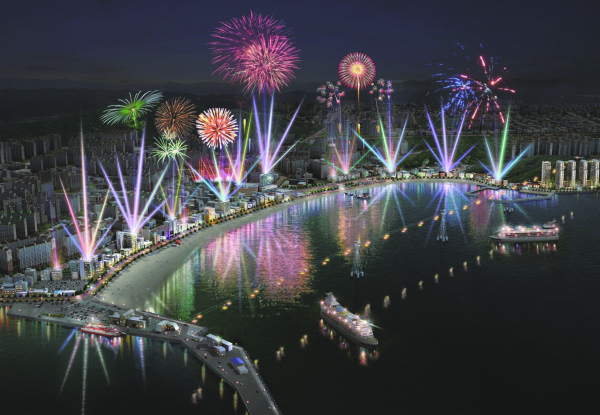
Another notable news is in the tourism industry. Pohang has recently been selected for the Complex Marine Leisure Tourism City Project organized by the Ministry of Oceans and Fisheries (MOF). Nine local governments have signed up for the project, and Yeongilman Special Tourist Zone of Pohang has been selected as one of the two sites for the project, together with Tongyeong. Park Sujeong, a city official from the Urban Planning Division of Pohang City, explains that the project aims to ultimately connect its coastal and urban areas as a unified system of tourism and living via Yeongilman Special Tourist Zone, and to develop Yeongilman into a global marine tourism hub through private investments and public finances. She also points out that its optimal location adjacent to both coastal and urban areas, its transportation infrastructure, and active investments, along with others, proved Pohang’s competitiveness in the project.
Pohang is now expanding its horizon. The hardships it encountered ironically motivated them to balance the growth of different industries and to move toward the future. It seems that Pohang could have a bright future, as it did in the past, by developing different future industries while maintaining its capability in the steel field.