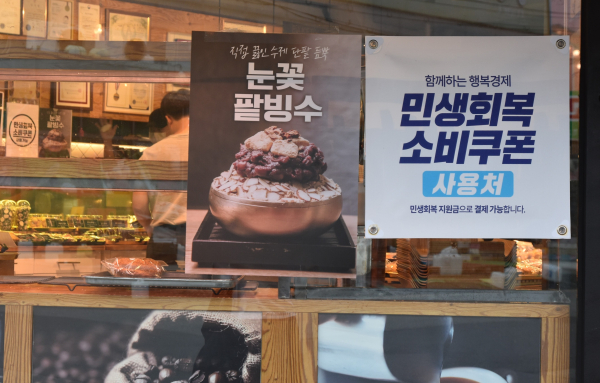
On July 21, the South Korean government began distributing consumer coupons, a cash-equivalent voucher program designed to stimulate domestic spending and support local businesses amid economic hardships. Often referred to as Livelihood Recovery Consumption Coupons in Korean, these vouchers are intended to encourage immediate consumption in everyday sectors such as dining, retail, and local services. While exact amounts may be greater based on the income status and area of residence, most citizens received 150,000 KRW.
By providing citizens with cash to spend within their communities, the government aims to promote regional economic activity by helping small businesses recover from recent downturns and maintain an overall economic momentum. To ensure that the coupons support relatively medium-sized enterprises and local businesses, the coupons are restricted to businesses below a certain annual net income threshold.
By August 20, the program had reached nearly 97% of eligible citizens, with around 49 million people receiving a total of 8.9 trillion KRW in coupons. Early usage trends indicate robust consumer engagement: within the first two weeks of distribution, roughly 46% of the coupons had already been spent. The bulk of spending has flowed into restaurants, which accounted for more than two-fifths of coupon usage. Beyond dining, households have directed significant sums toward daily necessities, underscoring the role of the program in easing immediate financial burdens, while a surprising share has gone into private education expenses, particularly tuition at private after-school academies, called “hagwon,” a sign that families are using the extra purchasing power to cover what many consider unavoidable costs. In response to this surge in consumer activity, retailers both large and small have launched special promotions, and local convenience stores report heavier foot traffic and increased daily sales compared to the previous month.
The program’s reception appears broadly positive, though predictions for its long-term impact differ. Supporters argue that the coupons provide timely support for small businesses and a psychological boost for consumers, restoring confidence and encouraging households to loosen their wallets. They suggest the program could act as a bridge, sustaining demand until broader economic conditions improve. Critics, however, warn that much of the spending has gone toward purchases families would have made regardless, meaning the net stimulus may be smaller than it appears. Others point out that the program’s benefits are temporary by design, likely to fade once the coupons are exhausted, leaving many issues like stagnant wages and regional inequality untouched and unresolved. A more cautious centrist view holds that while the coupons may not transform the economy, they serve as a useful cushion in a difficult year—buying time for households and businesses and giving policymakers more flexibility to implement longer-term reforms.
In line with the program’s own slogan, there is hope that these consumer coupons can serve as a prime mover for Korea’s economic recovery and renewed growth. While their ultimate impact will only become clear with time, the early signs of strong public engagement suggest a meaningful step in the right direction. As the initiative continues, many look forward with cautious optimism, expecting that the coupons will truly fulfill their role as a spark for broader stability and lasting momentum in the national economy.