A research team led by Professor Keehoon Kim (ME, GSCST), along with Ph.D. candidate Jaehyun Park, has developed a haptic device that can simultaneously enhance worker safety and operational efficiency in industrial environments. The study was recently published in the international robotics journal IEEE Transactions on Industrial Informatics.
Automation is becoming increasingly prevalent in high-risk industrial environments such as factories and steel mills. However, despite significant advancements in robotic technology, certain tasks — such as lump iron removal in steel production, which the study covers specifically — still demand the precision of direct human intervention. Even minor mistakes can result in serious accidents or costly system failures in these cases. Furthermore, most conventional robot control methods rely solely on visual feedback, often paired with joysticks or button-based interfaces that lack intuitiveness and tactile depth. The research team turned to digital twin technologies to address this, offering a more immersive and responsive solution for safe and precise remote control.
A digital twin (DT) is a virtual replica of a physical system, process, or environment that mirrors real-world conditions in real time. By continuously receiving data from sensors and connected devices, a DT system allows users to monitor and simulate real-life operations remotely through a digital interface. In this case, the team introduced two DT-based innovative haptic devices that provide lifelike remote control.
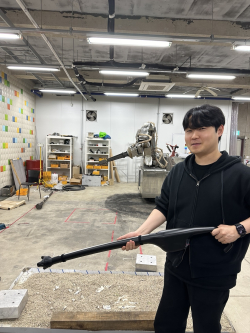
The “POstick-KF (Kinesthetic Feedback)” is a grounded haptic device with 13 linear guides and a spherical rotational module. It transmits the precise and lifelike force feedback felt by the robot, such as resistance when pushing or pulling, allowing users to perform delicate and controlled tasks based on tactile feedback.
Meanwhile, the “POstick-VF (Visuo-tactile Feedback)” is an ungrounded device that resembles a wireless vacuum cleaner, which allows for a tremendously higher degree of freedom and significantly better mobility. Rather than push and pull, the POstick-VF combines visual and tactile feedback using vibrations and graphical cues, enabling efficient operation even in larger or more complex environments.
Both devices were designed to resemble the size and shape of actual tools used in the field. This tool-like form factor allows users, especially novices, to adapt quickly and operate with confidence, significantly reducing training time. Operators can choose between the two interfaces based on their task complexity, working environment, and level of experience.