

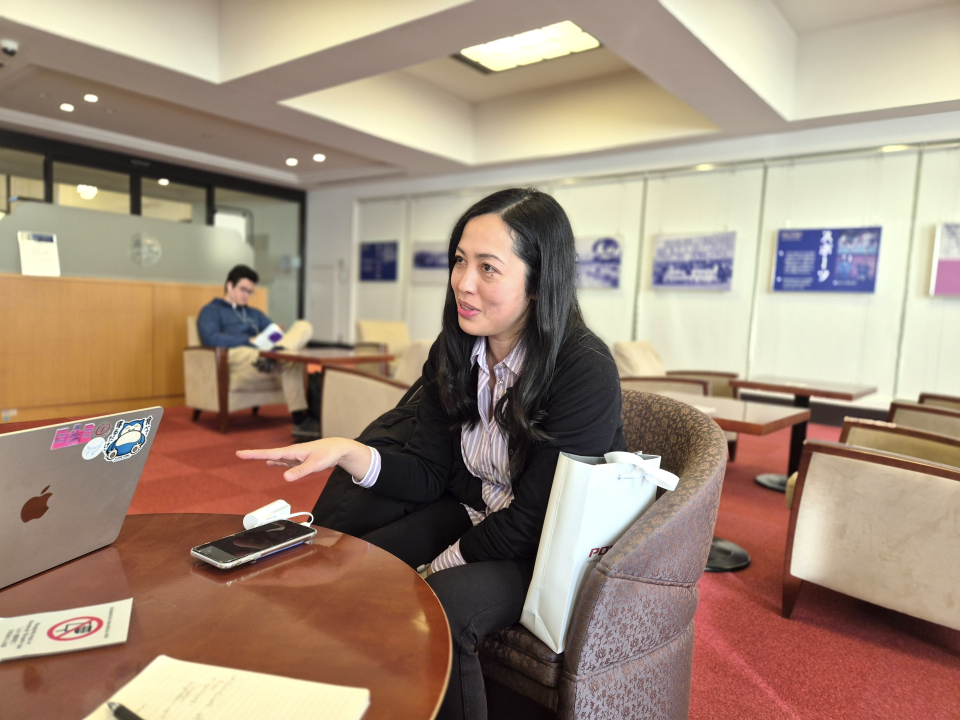
The Postech Times interviewed Professor Julie Ann de los Reyes of Kyoto University on Jan. 20.
Could you introduce us to your research interest?
I am an economic geographer, concerned with understanding economic systems and how geography interacts with the economy. My research focuses on the movement of investments towards particular countries at certain moments. Why does investment go in these places, or why are profits that are generated in those places sent elsewhere? How does the flow of money change the production of energy sources? This interface of economy and nature is what I am interested in. Currently, I study energy transition, particularly whether countries like the Philippines are able to or not able to transition swiftly along the prescribed timelines under the Paris Agreement.
What made you start your post-doctoral research on energy transition in Southeast Asia?
Coal is the single largest contributor to global CO2 emissions among fossil fuels, so phasing it out is at the forefront of climate policy. I was curious how countries like the Philippines, a country without coal as a natural resource, ended up becoming dependent on coal for power generation. Nearly 60% of the Philippines’ energy comes from coal, the same percentage as Indonesia - the biggest producer and exporter of coal, and also the main supplier of coals for the Philippines. From the point of view of resource security, transitioning to renewable energy seems like the logical step, to becoming more self-sustaining and less dependent on other countries.
One of my key motivations is to analyze what caused the Philippines to be tied to the coal-based energy system and show that it is not just resource endowment that determines energy dependency. There are all these other social factors, such as technological linkages with Japan and other external actors like the technology of other nations.
Can you tell us about the role social relations play in energy transition and the role Japan plays in Southeast Asia’s energy transition?
In energy research, there is a realization within academia that what is holding back energy transition now are not just technological factors, but existing policies, such as governmental policies, financial systems, and social resistance to certain technologies. In this sense, I always insist that transition is not just a technological shift, it requires a holistic, systemic shift in society.
There are a lot of linkages between South Asian countries and Japan in terms of technological transfer support usually through the Japan International Cooperation Agency (JAICA) and the Japan Bank of International Cooperation (JBIC). I focus on what kind of interventions they are making, and whether these investments are supportive of renewable energy or perpetuate fossil fuel dependency. Japan is a resource-poor country like South Korea so its ability to transition depends on sourcing its energy requirements, which is very high as a developed country. So, making new international supply chains economically viable is a big part of the equation. Many Southeast Asian economies still look to Japan, South Korea, and China for funding and technology as they navigate their energy transitions.
Over the next decade, these relationships could either accelerate a green transition or reinforce fossil fuel reliance. There is some optimism in countries like Japan, South Korea, and China because of their strong state involvement in economic planning. I do share some of the optimism because I think the ability to marshal investments in support of clean energy technologies is a big part of the battle won. And I do see Japan and South Korea moving in that direction.
